

Files
Download Full Text (553 KB)
Description
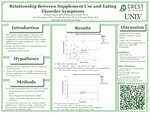
Background: Eating disorders encompass a spectrum of cognitive, behavioral, and physical symptoms related to eating and compensatory weight management behaviors. Supplement usage is becoming increasingly common, especially among younger populations. Using supplements has been shown to put adolescents at an increased risk for body dysmorphia, disordered eating behaviors, as well as other potentially harmful health effects, like electrolyte complications, heart issues, or even death. However, there is less research done on supplement usage in the college student population, especially in men. Across the past 10 years, supplement use in college students has increased 19.5%. Overall, there is a lack of consensus of what typical supplement use among college students looks like and what exactly they are used for. I hypothesize that students who use supplements will be at a higher risk of an eating disorder and that gender will moderate the strength of the association. Method and statistical analysis: 621 students completed the Clinical Impairment Questionnaire, Caffeine Consumption Questionnaire and the Dietary Supplement Questionnaire. A linear regression between eating disorder symptoms and supplement use was used to predict the relationship between the two. A moderation was used to assess if gender moderated the relationship between eating disorder symptoms and supplement usage. Conclusions: These findings indicate that supplement use was consistent between genders and did not increase ED impairment.
Publisher Location
Las Vegas (Nev.)
Publication Date
Spring 4-17-2026
Publisher
University of Nevada, Las Vegas
Language
English
Keywords
Eating Disorders; Supplement Use; Caffeine Use; Risk Factors
Disciplines
Feminist, Gender, and Sexuality Studies | Nutrition | Psychoanalysis and Psychotherapy
File Format
File Size
501 KB
Recommended Citation
Segura, Hannah; Menegatos, Lisa; Morabita, Danielle; and Nation, Maegan, "Relationship Between Supplement Use and Eating Disorder Symptoms" (2026). Undergraduate Research Symposium Posters. 301.
https://oasis.library.unlv.edu/durep_posters/301
Rights
IN COPYRIGHT. For more information about this rights statement, please visit http://rightsstatements.org/vocab/InC/1.0/
Included in
Feminist, Gender, and Sexuality Studies Commons, Nutrition Commons, Psychoanalysis and Psychotherapy Commons
Comments
Mentor: Kara Christensen Pacella