

Files
Download Full Text (472 KB)
Description
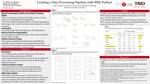
The UNLV Psychophysiology of Emotion and Personality Lab (PEPLab) utilizes a MATLAB based pipeline to process electroencephalogram (EEG) recordings. MATLAB is a proprietary software package, which limits the ability to analyze psychophysiological data and increases the financial burden of research. To increase the accessibility of data reduction skills, we have created and tested a new pipeline utilizing MNE-Python, an open source software package (Gramfort et al., 2013). In this pilot study, we utilized existing EEG recordings and examined the relationship between the Triarchic Model of Psychopathy and Error-Related Negativity (ERN) responses across incorrect and correct trials during a Letter Shock task and compared these findings to a previous study (Peixoto Couto, 2025). The pipeline was able to successfully replicate findings of an increased ERN response when participants were high in Boldness, as well as a decreased ERN response when participants were high in both Boldness and Disinhibition. While successful in the purposes of analyzing ERN responses, further work will be required to resolve EOG overcorrection present in frontal sensors. Future studies will also require pipeline adjustments to analyze different ERP responses.
Publisher Location
Las Vegas (Nev.)
Publication Date
Fall 11-21-2025
Publisher
University of Nevada, Las Vegas
Language
English
Keywords
Electroencephalography (EEG); EEG Processing; Open Source; Python; Psychopathy
Disciplines
Psychology | Social and Behavioral Sciences
File Format
File Size
412 KB
Permissions
Google Drive\Institutional Repository\OUR_OfficeOfUGResearch\Symposia\2025 Fall Symposium
Recommended Citation
Vazquez, Lesly and Liz Peixoto Couto, Ananda, "Creating a Data Processing Pipeline With MNE-python" (2025). Undergraduate Research Symposium Posters. 271.
https://oasis.library.unlv.edu/durep_posters/271
Rights
IN COPYRIGHT. For more information about this rights statement, please visit http://rightsstatements.org/vocab/InC/1.0/
Comments
Mentor: Stephen Benning