

Readership Map
The readership map above shows the impact of this collection worldwide! To browse the collection, keep scrolling.
About the Collection
COE 303: Promotes transfer students’ academic success and facilitates transition into UNLV community. Focus on university orientation, critical thinking, communication, multiculturalism, life-long learning, and citizenship. Requires outside of class community service or career-oriented fieldwork experience. Builds connections with faculty and transfer peers, college/community engagement, and improves academic skills.
-
Service-Informed Pathways Proposal
Joshua Works
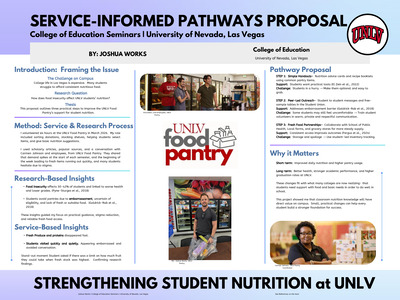
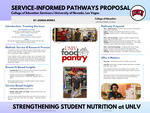
5-1-2026This project explores how food insecurity affects UNLV students’ nutrition and proposes practical ways to strengthen the UNLV Food Pantry. Through six hours of volunteer service and a review of research, I identified key barriers, including stigma, limited access to fresh food, and low awareness. The proposal recommends three actionable improvements: simple nutrition handouts, peer-led outreach to reduce stigma, and stronger partnerships to ensure consistent access to fresh produce. These steps aim to improve daily nutrition, increase pantry usage, and support better academic outcomes. This work combines hands-on service experience with research to offer realistic, low-cost solutions that can help more UNLV students succeed.
-
Worship Without Barriers
C. Niigel Porter
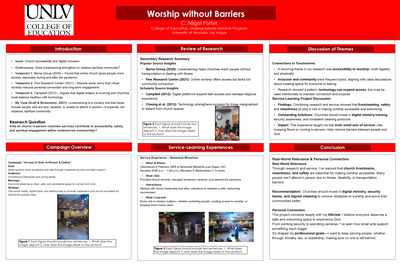
5-15-2025Issue: Church accessibility and digital inclusion.
Controversy: Does livestreaming strengthen or weaken spiritual community
Viewpoint 1: Barna Group (2020) – Found that online church gives people more access, especially during and after the pandemic.
Viewpoint 2: Pew Research Center (2021) – Reports some worry that virtual worship reduces personal connection and long-term engagement.
Viewpoint 3: Campbell (2012) – Argues that digital religion is evolving and churches must balance tradition with technology.
My View (Graff & Birkenstein, 2021): Livestreaming is a ministry tool that helps include people who are sick, isolated, or unable to attend in person—it expands, not replaces, spiritual community.
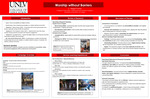
Research Question: How do church in-person volunteer services contribute to accessibility, safety, and spiritual engagement within underserved communities?