
Diamond Open Access | Peer-Reviewed | No Publication Fees
How can we build a future for teaching and mentoring creative work and research that honors core disciplinary traditions, supports interdisciplinary collaborations, and enhances transdisciplinary work? How can evolving digital technologies foster innovation in the interwoven work of teaching-researching-creating, while supporting the best of traditional practices in the arts, design, and media disciplines?
This peer-reviewed open access eJournal—collaboratively brought to life by the international Alliance for the Arts in Research Universities (a2ru) network, and a2ru member UNLV—provides a multimedia forum to address this and connected questions by exploring how creative work, teaching/mentoring, and knowledge creation/research are linked and in conversation with one another.
Call for Contributions | New themed issue
Ruptures and Rebirths
The Future of Creativity, Agency, and Education
We are entering an era of ruptures and possible rebirths for the arts: Current definitions of art are fracturing at the intersection of intensified technological acceleration, cultural upheaval, and political volatility. Shifting global economies are reshaping long-standing assumptions about creativity, labor, authorship, and the cultural value of artistic work. At the center of this transformation stands the figure of the artist—an identity undergoing radical redefinition, perhaps confronting what some have described as the “death” of its traditional form while maintaining timeless traits of making, imagining, and discovery.
What does it mean to make art, to experience art, or to support artistic practice in this moment, when algorithmic systems influence how cultural work is imagined, produced, circulated, and valued—and when both the embodied experience of art and the embodied experience of making art are reshaped by digital tools and mediated environments? How might emerging technologies simultaneously destabilize established creative identities and open pathways to new forms of agency, authorship, expression, and embodied engagement? And what responsibilities do higher education institutions have in preparing artists, designers, and media practitioners for a landscape in which cultural production is increasingly hybrid, contested, and globally interdependent?
Interrogating these shifts formed the foundation of our recent themed issue, Artificial Intelligence and Possible Futures for the Arts, which examined how emerging technologies using AI are reshaping creative labor, authorship, pedagogy, and cultural production.
For this new themed issue, we place commentary and critical reflection at the center. We invite educators, scholars, and creative practitioners to critically and productively respond to the arguments, tensions, provocations, and possibilities raised in Artificial Intelligence and Possible Futures for the Arts – and to expand the conversation.
See the Tradition-Innovations in Arts, Design, and Media Higher Education Themed Issue Call for Contributions for more information.
See the About this journal for a complete coverage of the journal.
Current Issue: Volume 1, Issue 1 (2023-2026) Artificial Intelligence and Possible Futures for the Arts
How are recent innovations in Artificial Intelligence (AI)—ones that change art processes and appear to produce creative works—transforming the creation of art and knowledge? The pace of these innovations and the discussions surrounding them challenge traditions in the arts, design, and media fields and encourage (if not force) us to consider the possible futures of the arts.
The editorial board of Tradition-Innovations in Art, Design, and Media Higher Education invited artists, performers, designers, and media creators in higher education to become a part of the discussion about AI’s effects on the arts in this inaugural issue of the journal.
How can artists, performers, designers, and media creators balance innovations and traditions in the Arts, Design, and Media higher education, and what can we learn from our fields’ reactions to AI?
As a practitioner, scholar, or mentor, what strategies are you using to address AI’s challenges to your work in the arts?
How is AI changing the relationship between educators/mentors and students?
What traditional—centuries-old—practices are beyond the reach of artificially generated work, and why? What does this tell us about human creativity, and creative processes in the face of AI?
How can we influence AI platforms in visionary and productive ways? What is important to consider beyond an immediate reactive stance?
How can we respond to the unintended consequences of AI and participate in iterating positive advancements?
How can the arts empower contemporary society to identify longer-term opportunities—and challenges—of AI?.
This special issue call received so many fascinating—and often surprising—contributions that the guest editors decided to publish this issue in several parts. Julian Kilker introduces the first part with articles that stretch our understanding of artistic and research collaborations. Leah Howd introduces the second part, which focuses on opportunities and challenges in teaching in the age of generative AI. The third part - introduced by Sarah O'Connell - includes contributions about art/science research integration using machine learning, controversies surrounding the exhibition of artists using Generative AI enhancements, making visible traditional artisans and empowering traditionally marginalized populations through the use of generative AI in the design process. Evocative and provocative “co-created” human and AI-generated visuals accompany each contribution, eliciting critical reflection on generative AI outputs, productive human interventions in human-AI “co-creation,” and possibilities and limits of AI technologies.
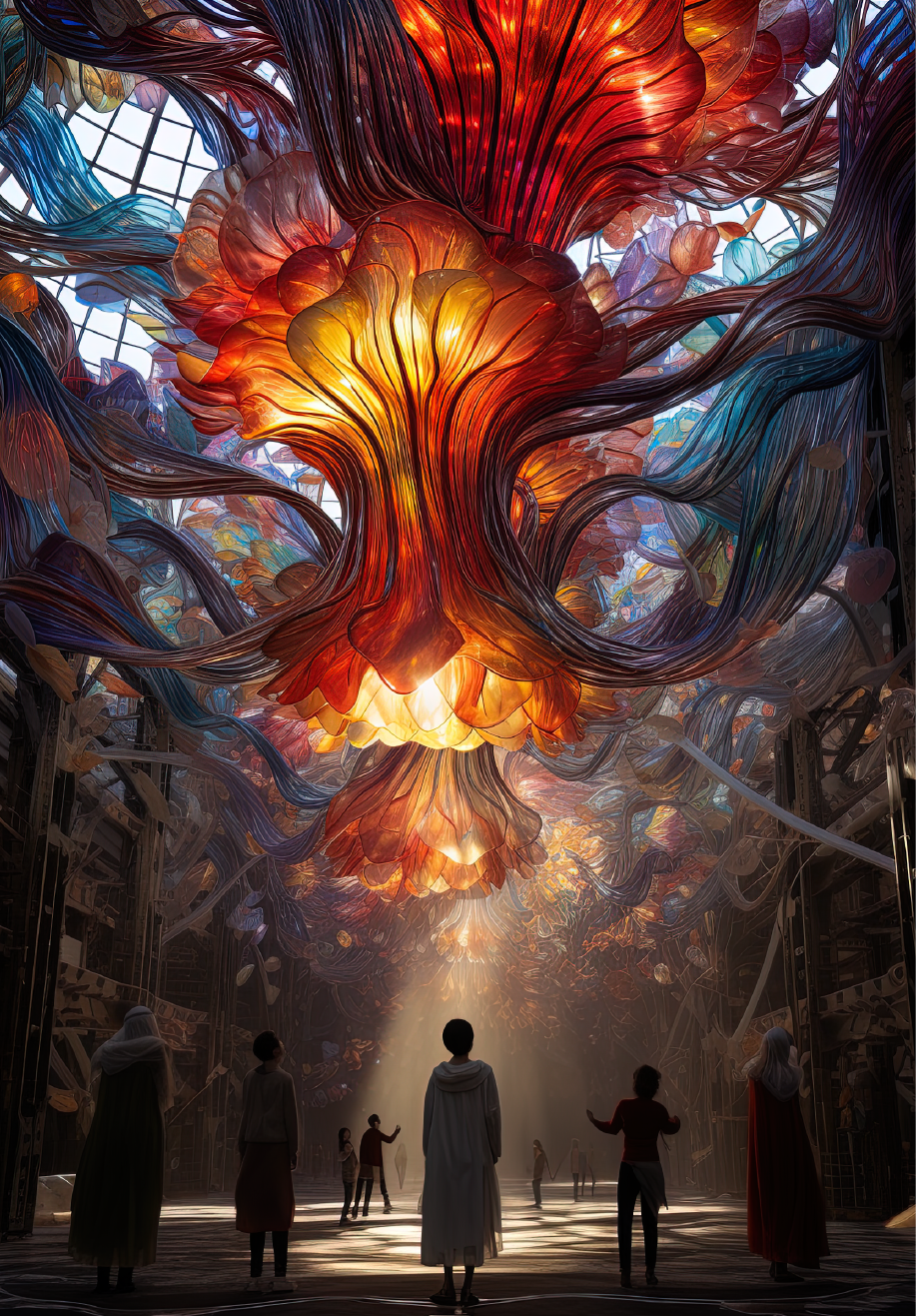
Josh Vermillion, UNLV School of Architecture, created the cover art for this special edition and the banner for the new journal using a workflow described in his article in this special issue.
From the Editors
Articles
Choreographing Shadows: Interdisciplinary Collaboration to Orchestrate Ethical AI Image-Making
Mark Burchick and Diana Pasulka
Giving Up Control: Hybrid AI-Augmented Workflows for Image-Making
Joshua Vermillion
Teaching Creatives to be A.I. Provocateurs: Establishing a Digital Humanist Approach for Generative A.I. in the Classroom
Joshua A. Fisher
Generative Algorithms for Art and Architecture: A Collaborative Teaching Approach
Sam Keene and Benjamin Aranda
Aberrant Creativity: AI Art Exhibition Catalyzing Conversations Among Artists, Educators, and Professionals
Caleb Kicklighter and Jinsil Hwaryoung Seo
Modern Tools, Ancient Skills: An Attempted Dialogue between AI, Design and Traditional Craft
Paolo Cardini and Juan C. Noguera
Intersections of Living and Machine Agencies: Art-Based Models of Adaptive Conversation with the More-than-Human World
Carlos Castellanos
Podcast
Learning Object
Hands Are Hard: Unlearning How We Talk About Machine Learning in the Arts
Oscar K. Keyes and Adam Hyland
| Special Issue Editors | Leah Howd, M.S., Fen Kennedy, Ph.D., Julian Kilker, Ph.D., Sarah O'Connell, MDra |
|---|---|
| Editor-in-Chief | Yvonne Houy, Ph.D. |
It has been a privilege working with the guest editors of this special edition who each brought a different perspective to the challenges and opportunities of this rapidly emerging technology.
A grateful thank you also goes out to the editorial board members of Tradition-Innovation in Art, Design, and Media Higher Education - Angela Brommel, Felice Amato, Keli DiRisio, Perrin Teal Sullivan, Nils Gore, J.R. Campbell, Sarah O'Connell, Fen Kennedy, and Leah Howd - and the numerous anonymous peer reviewers who generously gave their time and expertise for extensive comments to contributors.
Yvonne Houy, Editor-in-Chief