

Files
Download Full Text (1.2 MB)
Description
Introduction: Mice have been observed in both laboratory and field settings to exhibit a tendency to remain near corners and walls. This trait is known as positive thigmotaxis. Thigmotaxis has been recognized as a fundamental aspect of rodent behavior and used extensively as an anxiety index in mice. Although this characteristic has been recognized as a fundamental aspect of rodent behavior, thigmotaxis has been extensively studied in rectangular and circular environments. However, there is a notable lack of understanding of how alternative geometric configurations can influence this behavior.
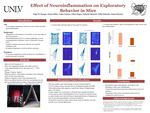
Methods and Approach: Using a grid overlaid on the environment the mice were in, we were able to extract the X and Y points to describe the horizontal and vertical positioning of the mice within the environment. These points were obtained from previous experiments involving male and female mice before and after inducing neural inflammation. We were able to track the mice both in time spent and distance traveled within each subdivided region of the shaped environments. This was done by using a neural implant to track where the mouse was within the environment. After collection, data was inputted into MATLAB for analysis. Using custom written code to analyze the data we were able to evaluate the potential sex-specific differences before and after neural inflammation.
Results: Our preliminary analysis has provided a strong framework for evaluating and analyzing the difference in both time spent in different regions in the environments and total distance traveled. However further examination will be needed for us to draw conclusions on how thigmotactic behavior is affected by these different environments.
Conclusions: Our findings indicate that insights from this research could be used to design experimental mazes to elicit specific spatial behaviors in mice. Environments can be created to either draw the mice to the center of the environment or to draw them closer to the wall for the experimental design. This will save lots of time that is currently spent on designing environments for mice that may or may not have the desired effect. We also concluded that the information learned from this research could be used to better design rodent enclosures for pet owners to create an environment that is less stressful and more calming for the mice. This could possibly change what type of enclosures are currently being sold to owners of mice.
Publication Date
Fall 11-21-2025
Publisher
University of Nevada, Las Vegas
Language
English
Keywords
neuroscience; mice; thigmotaxis; maze; MATLAB; neuroinflammation; Alzheimer's disease; dementia; rodent
Disciplines
Cognitive Neuroscience | Nervous System Diseases | Neuroscience and Neurobiology
File Format
File Size
1232 KB
Recommended Citation
Pompa, Gage; Mitic, Ariana; Gomez, Yader; Hagos, Lilian; and Montiel, Orlando, "Effect of Neuroinflammation on Exploratory Behavior in Mice" (2025). Undergraduate Research Symposium Posters. 298.
https://oasis.library.unlv.edu/durep_posters/298
Rights
IN COPYRIGHT. For more information about this rights statement, please visit http://rightsstatements.org/vocab/InC/1.0/
Comments
Mentor: James Hyman