

Readership Map
The readership map above shows the impact of this collection worldwide! To browse the collection, keep scrolling.
About the Collection
Welcome to UNLV’s Best Teaching Practices Expo, where faculty share their research-based ideas for improving teaching across campus. Each poster you find here describes a teaching practice that: Addresses a particular need to improve teaching; Benefits UNLV students in particular; and Applies in a variety of teaching contexts. The expo is a signature event for UNLV offered through the Faculty Center, which promotes teaching development, research and career planning.
-
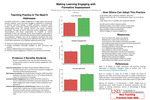
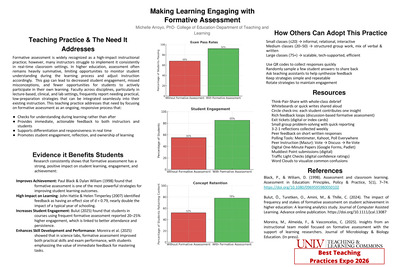
Making Learning Engaging With Formative Assessment
Michelle A. Arroyo
4-30-2026Benefits of formative assessment: increases student engagement, provides immediate feedback for teachers and students, helps differentiate instruction, encourages self-reflection and self-regulated learning, and improves overall student achievement.
-
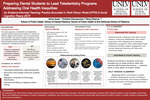
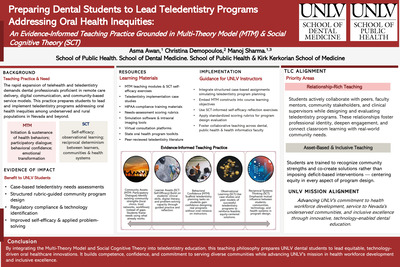
Preparing Dental Students to Lead Teledentistry Programs Addressing Oral Health Inequities: An Evidence-Informed Teaching Practice Grounded in Multi-Theory Model (MTM) & Social Cognitive Theory (SCT)
Asma Awan, Christina Demopoulos, and Manoj Sharma
4-30-2026The rapid expansion of telehealth and teledentistry demands dental professionals proficient in remote care delivery, digital communication, and community-based service models. This practice prepares students to lead and implement teledentistry programs addressing oral health inequities among underserved and rural populations in Nevada and beyond
-
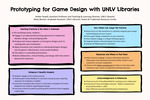
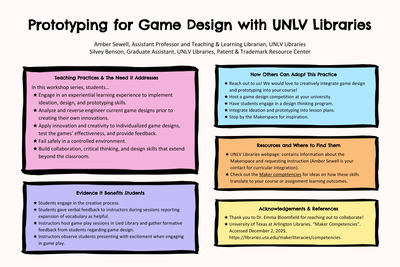
Prototyping for Game Design With UNLV Libraries
Silvey Benson and Amber Sewell
4-30-2026Involving students in a hands-on creative way to implement ideation, design, and prototyping skills gives students the opportunity to apply the theory of iterative design. Students analyze and reverse engineer current game designs prior to beginning their own innovations. They are then encouraged to apply innovation and creativity to their own game designs, test the games’ effectiveness through having others play their game and provide feedback, and fail safely in a controlled environment. Students will ideally increase their tolerance for failure through the implementation of the iterative design process while gaining a variety of skills that will serve them outside the classroom.
-
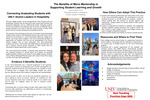
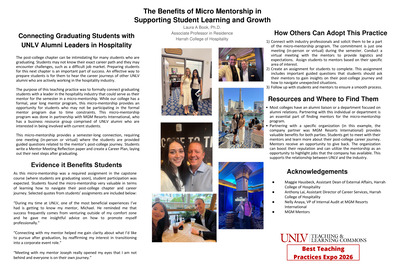
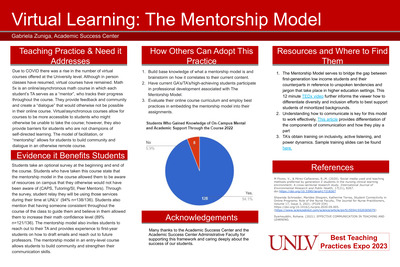
The Benefits of Micro Mentorship in Supporting Student Learning and Growth
Laura A. Book
4-30-2026An overview of how pairing students with industry mentors can benefit their growth post graduation.
-
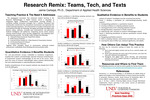
Research Remix: Teams, Tech, and Texts
Jaime Carbajal
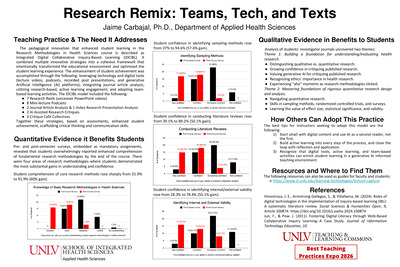
4-30-2026The pedagogical innovation that enhanced student learning in the Research Methodologies in Health Sciences course is described as Integrated Digital Collaborative Inquiry-Based Learning (IDCIBL). The IDCIBL approach leveraged digital tools (lecture videos, podcasts, recorded poster presentations, and Artificial Intelligence (AI) platforms), integrated journal article analysis, utilized research-informed active learning, and included team-based learning activities. The combination of multiple innovative strategies into the IDCIBL model intentionally transforms the educational environment and optimizes the student learning experience, relating to the TLC priority area of teaching and assessments in the age of Gen AI.
-
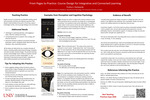
From Pages to Practice: Course Design for Integrative and Connected Learning
Prutha Deshpande
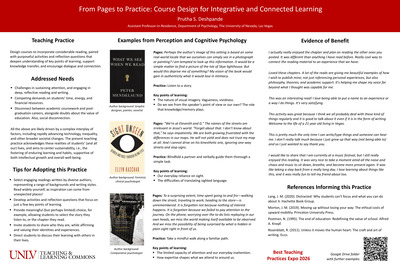
4-30-2026The poster provides resources for the design of courses to incorporate considerable reading, paired with purposeful activities and reflection questions that deepen understanding of key points of learning, support knowledge transfer, and encourage dialogue and connection.
-
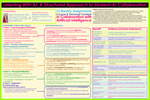
Learning With AI: A Structured Approach to Student-AI Collaboration
April Ursula Fox
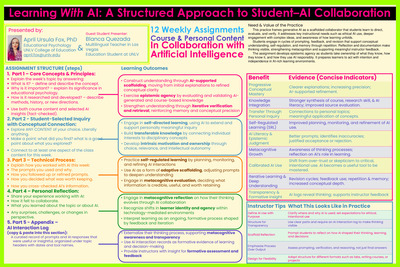
4-30-2026The rapid integration of generative artificial intelligence (AI) into higher education has created an urgent need for instructional models that move beyond tool use toward intentional, pedagogically grounded practice. This study presents a structured assignment design that positions AI as a scaffolded collaborator within undergraduate educational psychology courses. Across a multi-part, semester-long sequence, students engage in concept explanation, self-directed inquiry, AI-supported knowledge construction, and reflective documentation of their learning process. Findings from recurring student artifacts indicate progressive gains in conceptual understanding, integration of research sources, and transfer of knowledge to personally meaningful contexts. Students demonstrate increased capacity for self-regulated learning through iterative prompting, evaluation of AI-generated content, and systematic verification of information. Reflective components further reveal the development of metacognitive awareness and a calibrated, critical stance toward AI, shifting from initial over-trust or skepticism to intentional and responsible use. This work contributes a replicable model for integrating generative AI into higher education that foregrounds epistemic agency, metacognition, and ethical AI literacy. By framing AI as a form of adaptive scaffolding within inquiry-based learning, the assignment supports deeper engagement with disciplinary content while preparing students to navigate AI-rich knowledge environments with autonomy and critical judgment.
-
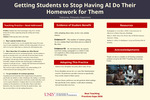
Getting Students to Stop Having AI Do Their Homeworkfor Them
Todd Jones
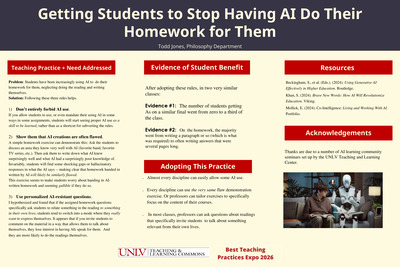
4-30-2026There are three simple rules, that, if followed, should cut down on the amount that students use AI to do their homework for them.
-
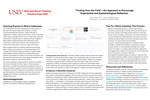
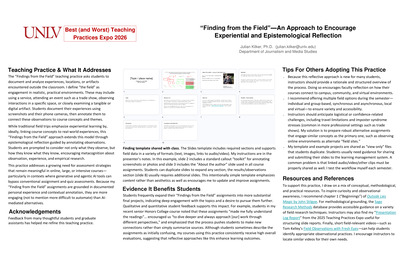
“Finding from the Field”—An Approach to EncourageExperiential and Epistemological Reflection
Julian Kilker
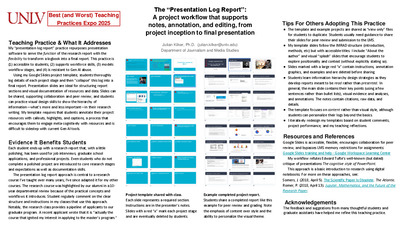
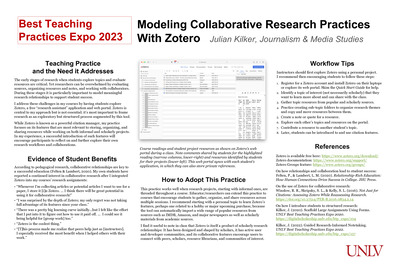
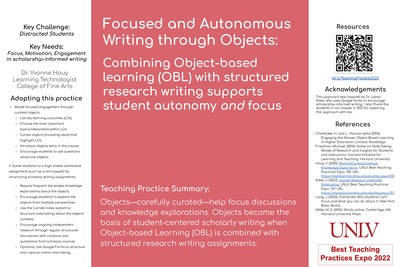
4-30-2026The “Findings from the Field” teaching practice asks students to document and analyze experiences, locations, or artifacts encountered outside the classroom. While traditional field trips emphasize experiential learning by, ideally, linking course concepts to real-world experiences, this “Findings from the Field” approach extends this model through epistemological reflection guided by annotating observations. Students are prompted to consider not only what they observe, but how they know what they know, encouraging metacognition about observation, experience, and empirical research.
-
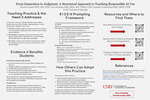
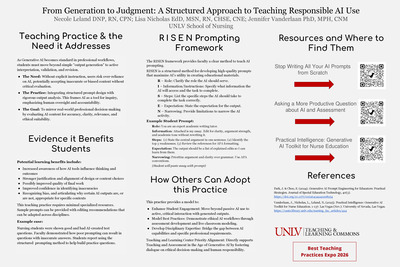
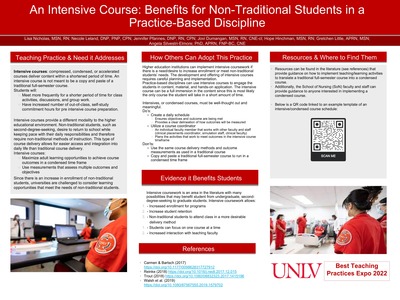
From Generation to Judgment: A Structured Approach to Teaching Responsible AI Use
Necole Leland, Lisa Nicholas, and Jennifer Vanderlaan
4-30-2026A structured approach to teaching responsible use of generative AI in nursing education is critical. As AI becomes increasingly integrated into professional practice, students must move beyond simple AI content generation to critically evaluate and refining AI outputs. Using the RISEN prompting framework to guide learners in designing effective prompts while also emphasizing analysis of accuracy, relevance, bias, and ethical considerations in the output. Through classroom modeling and applied activities, students engage actively with AI as a tool for inquiry rather than passive consumption. This approach offers a practical and adaptable model for integrating ethical and effective AI use across disciplines.
-
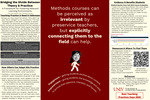
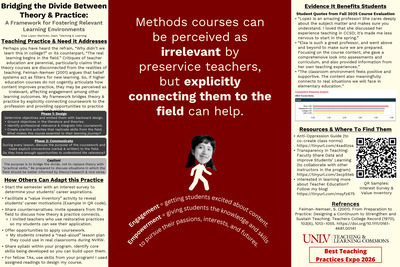
Bridging the Divide Between Theory & Practice: A Framework for Fostering Relevant Learning Environments
Elsa Lopez-Martinez
4-30-2026This poster presents a framework for bridging the gap between theory and practice in teacher education by designing relevant learning experiences that better prepare preservice teachers. Grounded in seminal teacher education literature, the approach explicitly connects coursework to professional applications while preserving the integrity of theoretical foundations. The framework emphasizes ongoing communication of purpose and alignment across courses. Additional strategies include integrating career-focused activities, facilitating reflective exercises, inviting practitioner perspectives, and providing applied assignments. Evidence from student feedback highlights increased engagement, confidence, and perceived relevance.
-
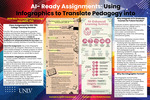
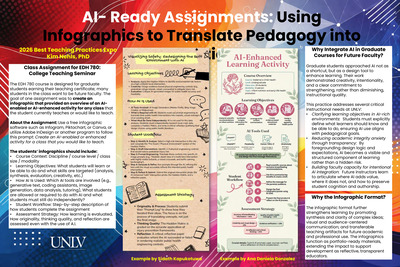
AI- Ready Assignments: Using Infographics to Translate Pedagogy into
Kim Nehls
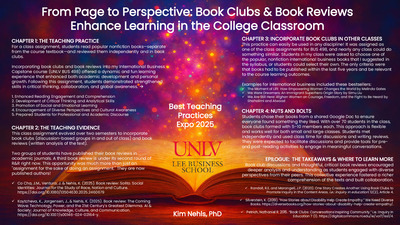
4-30-2026I developed an AI teaching infographic assignment in a doctoral-level Seminar in College Teaching (EDH 780) that requires students to design their own original course assignment for any course that meaningfully integrates AI, and then they communicate the assignment visually through an infographic.
-
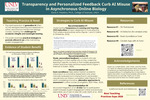
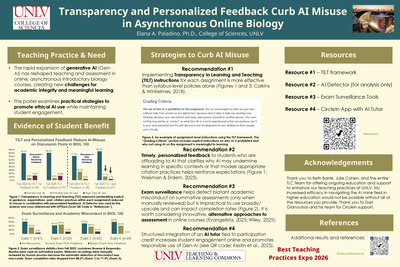
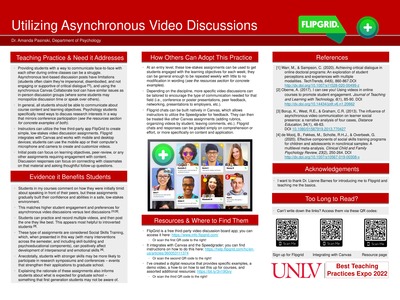
Transparency and Personalized Feedback Curb AI Misuse in Asynchronous Online Biology
Elana A. Paladino
4-30-2026The rapid expansion of generative AI (Gen-AI) has reshaped teaching and assessment in online, asynchronous introductory biology courses, creating new challenges for academic integrity and meaningful learning. This poster examines practical strategies to promote ethical AI use while maintaining student engagement. Transparency of instructions and timely, personalized feedback were found to curb AI misuse in online discussion posts. Structured use of AI tutors encouraged responsible engagement with Gen-AI, and surveillance methods for summative exams had mixed effects.
-
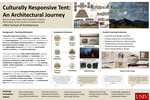
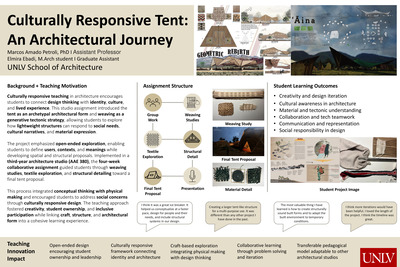
Culturally Responsive Tent: An Architectural Journey
Marcos Amado Petroli and Elmira Ebadi
4-30-2026Culturally responsive teaching in architecture encourages students to connect design thinking with identity, culture, and lived experience. This studio assignment introduced the tent as an archetypal architectural form and weaving as a generative tectonic strategy, allowing students to explore how lightweight structures can respond to social needs, cultural narratives, and material expression.
-
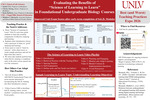
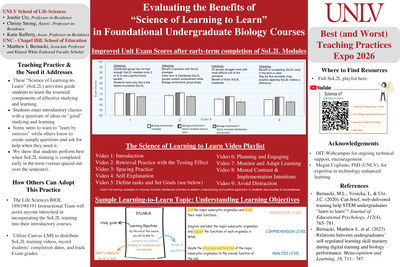
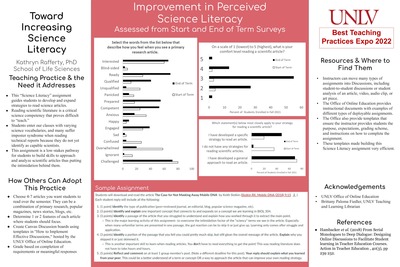
Evaluating the Benefits of “Science of Learning to Learn” in Foundational Undergraduate Biology Courses
Kathryn M. Rafferty, Jenifer Utz, Christy Strong, and Matthew Bernacki
4-30-2026Our objective was to foster increased retention of freshman student and subsequent progression into upper division coursework by incorporating learning skill development and motivational activities into the Introductory Biology courses (BIOL190/191). Enhancement of the introductory biology courses at UNLV has the potential to improve the educational experiences of thousands of students, since about 600 to 800 students enroll in the introductory biology courses each semester. We have previously developed a multimedia learning skill intervention called "The Science of Learning to Learn" which covers the importance of self-testing, spacing out and scheduling study sessions, and managing one's goals, habits, and learning environment. We investigated the effectiveness of providing the skill training early in the semester (i.e. in weeks 3 and 4) versus distributing the training throughout the semester (i.e. in weeks 3/4, 7, and 11). Students (N=465 of 685 enrolled; 77%) consented to be randomized into blocked, distributed, or biology-focused multimedia learning activities and 267 completed all assignments (57%). Groups received access to three modules in Week 3 and Week 4 and additional modules in Week 7 and Week 11. Those who completed modules earned credit towards participation grades and effects of assignment completion were tested by observing group means on exams for Units 1, 2, and 3 and the cumulative final. Learners who completed early skill training outperformed those receiving training on a distributed schedule by a statistically detectable 8.34 points per exam (p = .003). In summary, our results indicated that early exposure to learning skills training followed by a longer period to enact recommended approaches improves test scores by better addressing challenges encountered when undergraduates engage in active learning and studying. Our learning skill and motivational support materials, as well as other biology content materials, can be shared for broader adoption within the higher education community (e.g., on Canvas Commons).
-
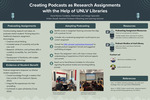
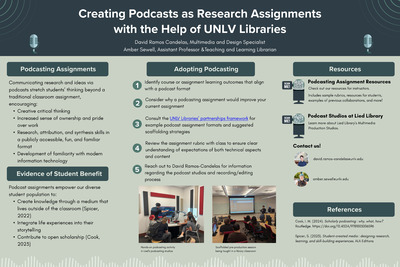
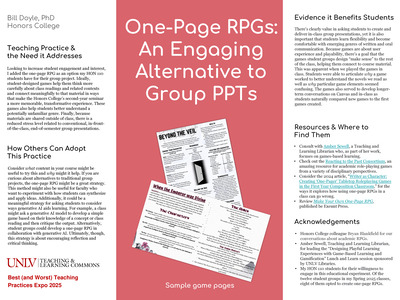
Creating Podcasts as Research Assignments With the Help if UNLV Libraries
David Ramos Candelas and Amber Sewell
4-30-2026Communicating research and ideas via podcasts stretch students’ thinking beyond a traditional classroom assignment, encourgaging: Creative critical thinking Increased sense of ownership and pride over work Research, attribution, and synthesis skills in a publicly accessible, fun, and familiar format
-
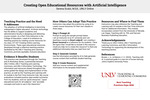
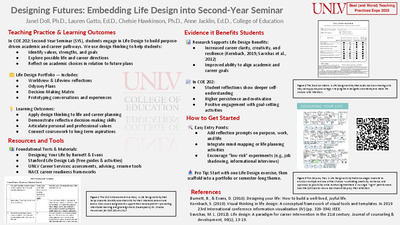
Creating Open Educational Resources with Artificial Intelligence
Serena Scalzi
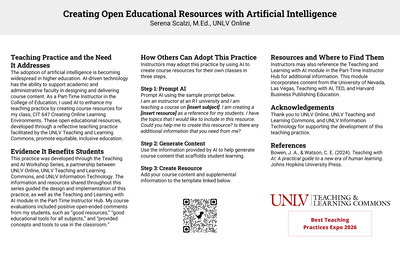
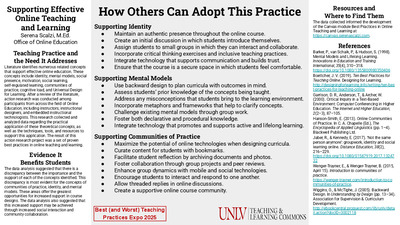
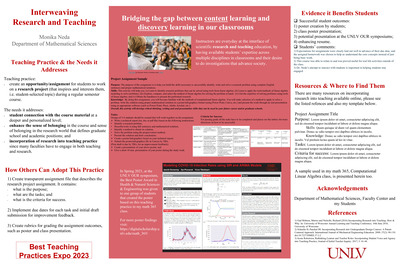
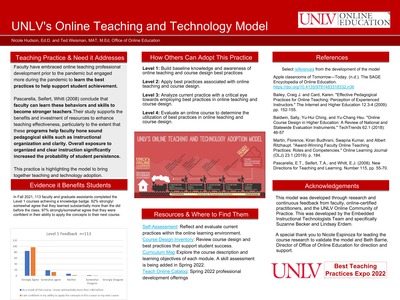
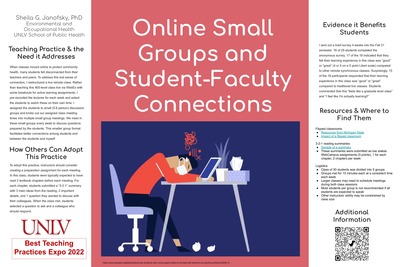
4-30-2026The adoption of artificial intelligence is becoming widespread in higher education. AI-driven technology has the ability to support academic and administrative faculty in designing and delivering course content. As a Part-Time Instructor in the College of Education, I used AI to enhance my teaching practice by creating course resources for my class, CIT 647 Creating Online Learning Environments. These open educational resources, developed through a reflective teaching practice facilitated by the UNLV Teaching and Learning Commons, promote equitable, inclusive education.
-
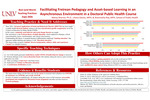
Facilitating Freirean Pedagogy and Asset-based Learning in an Asynchronous Environment in a Doctoral Public Health Course
Manoj Sharma, Liliana Davlos, and Sharmistha Roy
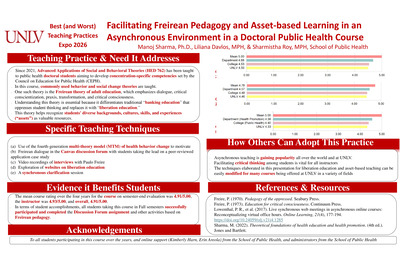
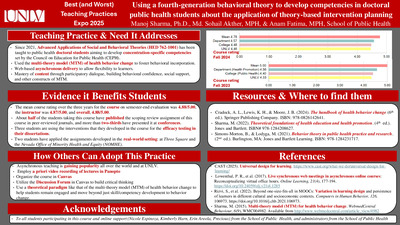
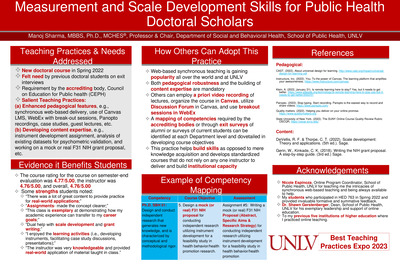
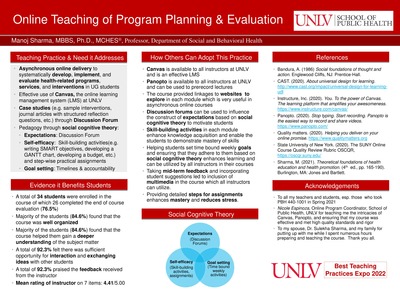
4-30-2026The Department of Social and Behavioral Health offers an asynchronous course, Advanced Applications of Social and Behavioral Theories (HED 762), to doctoral students in public health. In this course, commonly used behavior and social change theories are taught. One such theory is the Freirean theory of adult education, which emphasizes dialogue, critical conscientization, praxis, transformation, and critical consciousness. The instructor of this course uses a variety of methods to imbibe this pedagogy that comprise (a) the use of the fourth-generation multi-theory model (MTM) of health behavior change to motivate students, (b) Freirean dialogue in the Canvas discussion forum with students taking the lead on a peer-reviewed application case study, (c) video recordings of interviews with Paulo Freire, (d) exploration of websites on liberation education, (e) synchronous clarification session, and (e) review of Freire’s books. In this presentation, a duo team of doctoral students (one international and one minority domestic) who participated in this course in Fall 2025 shares their experiences. Furthermore, the mean course rating over the four years for the course on semester-end evaluation was 4.91/5.00, the instructor was 4.93/5.00, and overall, 4.91/5.00.
-
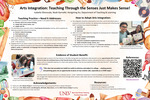
Arts Integration: Teaching Through the Senses Just Makes Sense!
Isabella Shenouda, Noah Karnafel, and Hongming Xu
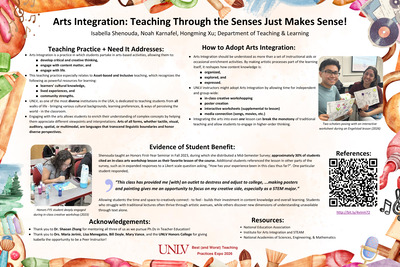
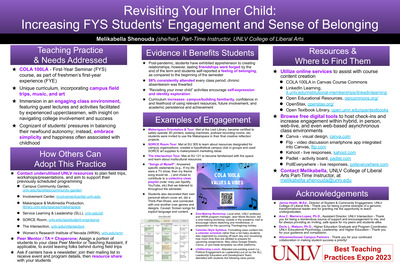
4-30-2026Arts Integration is a high-impact teaching practice for both higher education and K-12 settings. Because students bring diverse backgrounds, learning preferences, and ways of making meaning, the arts offer flexible, multi-sensory pathways to content comprehension that traditional lecture-based and text-based instruction often cannot. Drawing on classroom evidence from an Honors First-Year Seminar at UNLV in which students identified an arts-based workshop as their favorite lesson, we argue that creative, hands-on activities deepen knowledge retention and foster genuine intellectual engagement. Arts Integration is inherently an asset-based and inclusive practice, as it encourages students to connect through various sensory learning experiences, whether that be tactile, visual, auditory, spatial, or multimodal. As one of the most diverse universities in the nation, integrating arts-based learning at UNLV honors the full range of cultural perspectives and learning styles students bring to the classroom. Our research recommends that UNLV instructors incorporate even a single in-class creative activity to disrupt lecture monotony and promote higher-order thinking. Resources such as the National Education Association and the Institute for Arts Integration and STEAM are identified as accessible entry points for faculty interested in adopting this approach.
-
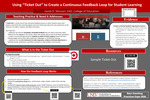
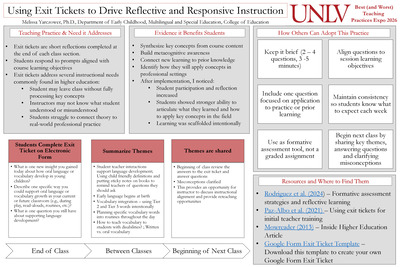
Using “Ticket Out” to Create a Continuous Feedback Loop for Student Learning
Jacob D. Skousen
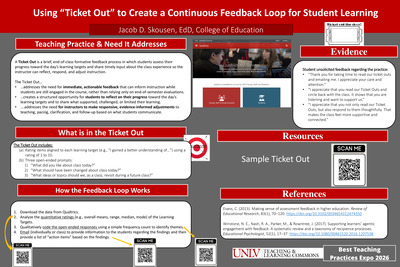
4-30-2026This presentation highlights the use of a brief end-of-class “Ticket Out” to create a continuous feedback loop for student learning. Students reflect on learning targets and provide feedback on the class experience, which is then analyzed and used to guide instructor response, follow-up communication, and instructional adjustments. The practice supports reflective teaching, student voice, and timely, responsive instruction.
-
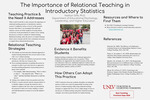
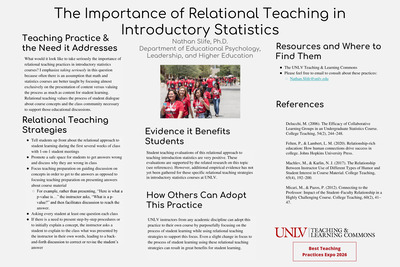
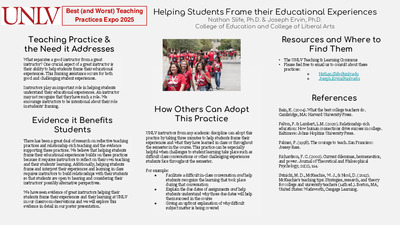
The Importance of Relational Teaching in Introductory Statistics
Nathan Matthew Slife
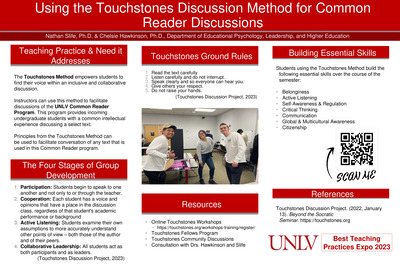
4-30-2026This poster presents relational teaching strategies for introductory statistics courses.
-
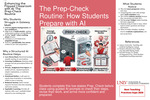
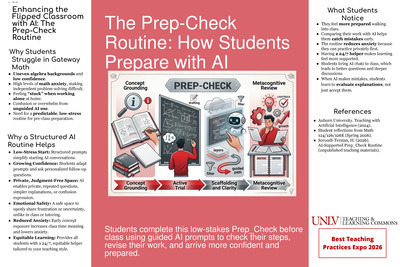
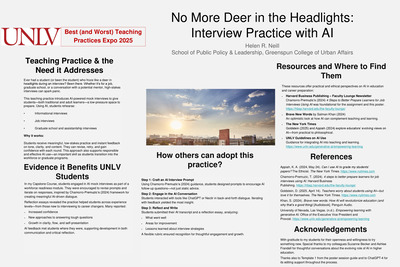
The Prep‑Check Routine: How Students Prepare with AI
Homa Soroudi-Terzian
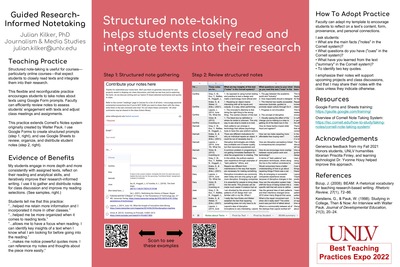
4-30-2026This poster presents a simple, repeatable Attempt & Audit routine that supports students in using AI as a learning partner rather than a shortcut. The Prep_Check structure guides students to attempt a problem on their own, ask AI for help on only one part, compare their work with the AI’s reasoning, and reflect on differences. This routine promotes metacognition, reduces anxiety, and helps students build confidence and independence in gateway math courses.
-
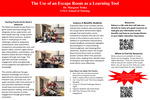
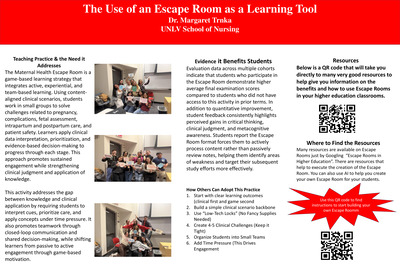
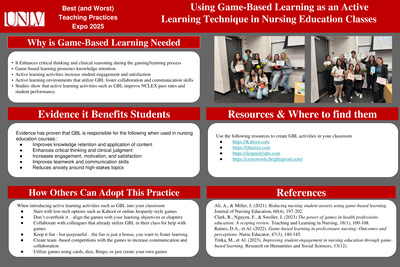
The Use of an Escape Room as a Learning Tool
Margaret Trnka
5-1-2026The use of escape rooms as an active learning strategy in nursing education promotes student engagement, clinical reasoning, and teamwork. By integrating unfolding patient scenarios with time-sensitive problem-solving tasks, escape rooms align with the principles of game-based learning and the Clinical Judgment Measurement Model (CJMM). This approach encourages students to recognize cues, prioritize interventions, and apply evidence-based practice in a collaborative environment. Incorporating escape rooms into nursing curricula has been associated with increased student satisfaction, improved knowledge retention, and enhanced readiness for clinical practice and Next Generation NCLEX (NGN) expectations.
-
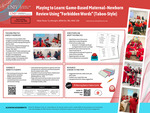
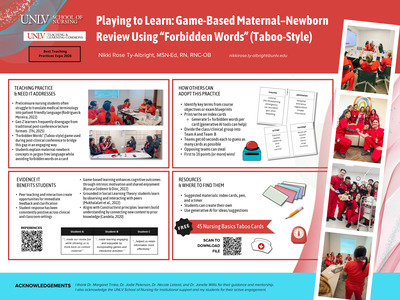
Playing to Learn: Game-Based Maternal-Newborn Review Using "Forbidden Words" (Taboo-Style)
Nikki Rose Ty-Albright
4-30-2026TEACHING PRACTICE & NEED IT ADDRESSES Prelicensure nursing students often struggle to translate medical terminology into patient-friendly language (Rodrigues & Moreira, 2022) Gen Z learners frequently disengage from traditional post-conference lecture formats (Thi, 2025) "Forbidden Words" (Taboo-style) game used during post-clinical conference to bridge this gap in an engaging way Students explain maternal-newborn concepts in jargon-free language while avoiding forbidden words on a card
-
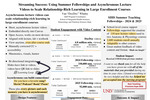
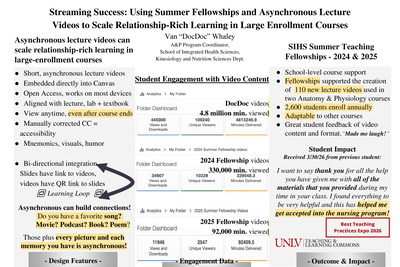
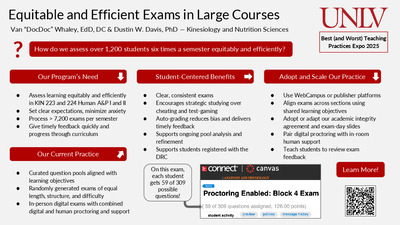
Streaming Success: Using Summer Fellowships and Asynchronous Lecture Videos to Scale Relationship-Rich Learning in Large Enrollment Courses
Van "DocDoc" Whaley
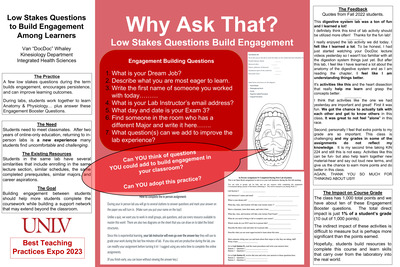
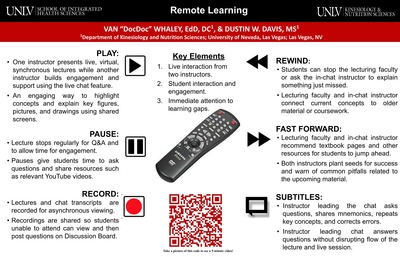
4-30-2026Supported by SIHS Summer Teaching Fellowships, this initiative developed 110+ asynchronous lecture videos embedded in Canvas to enhance accessibility, engagement, and alignment across large-enrollment A&P courses. Results include 92,000 minutes of views for the 2025 vides, 330,000 minutes viewed of the 2024 videoss, and over 4.8 million minutes of total student engagement and documented impact on student outcomes and program scalability.